.png)
Discover how Krista Skalde, Chief Talent Officer and Operating Partner at Inovia Capital thinks about VC Talent and Platform. In this Q&A she highlights how intentional networks, people data, and human-centered use of technology and AI are becoming core drivers of value creation in venture capital.

At Getro, we’re lucky to work with Platform leaders who shape the way Founders learn, grow, hire, raise, and stay connected. These are the people building the “infrastructure of support” inside venture funds, the ones Founders call when they need clarity, introductions, strategy, or community.
This month, we’re excited to spotlight Krista Skalde, Chief Talent Officer and Operating Partner at Inovia Capital. Krista embodies what makes the Platform community exceptional: a global perspective, deep empathy for Founders, and a strategic understanding of how networks, people data, and talent systems fuel value creation. Her career spans a tech startup, consulting, global companies, including a sovereign wealth fund, and now a leading Canadian VC firm. Each chapter reinforces her core belief: a firm’s biggest competitive advantage is its people and its network.
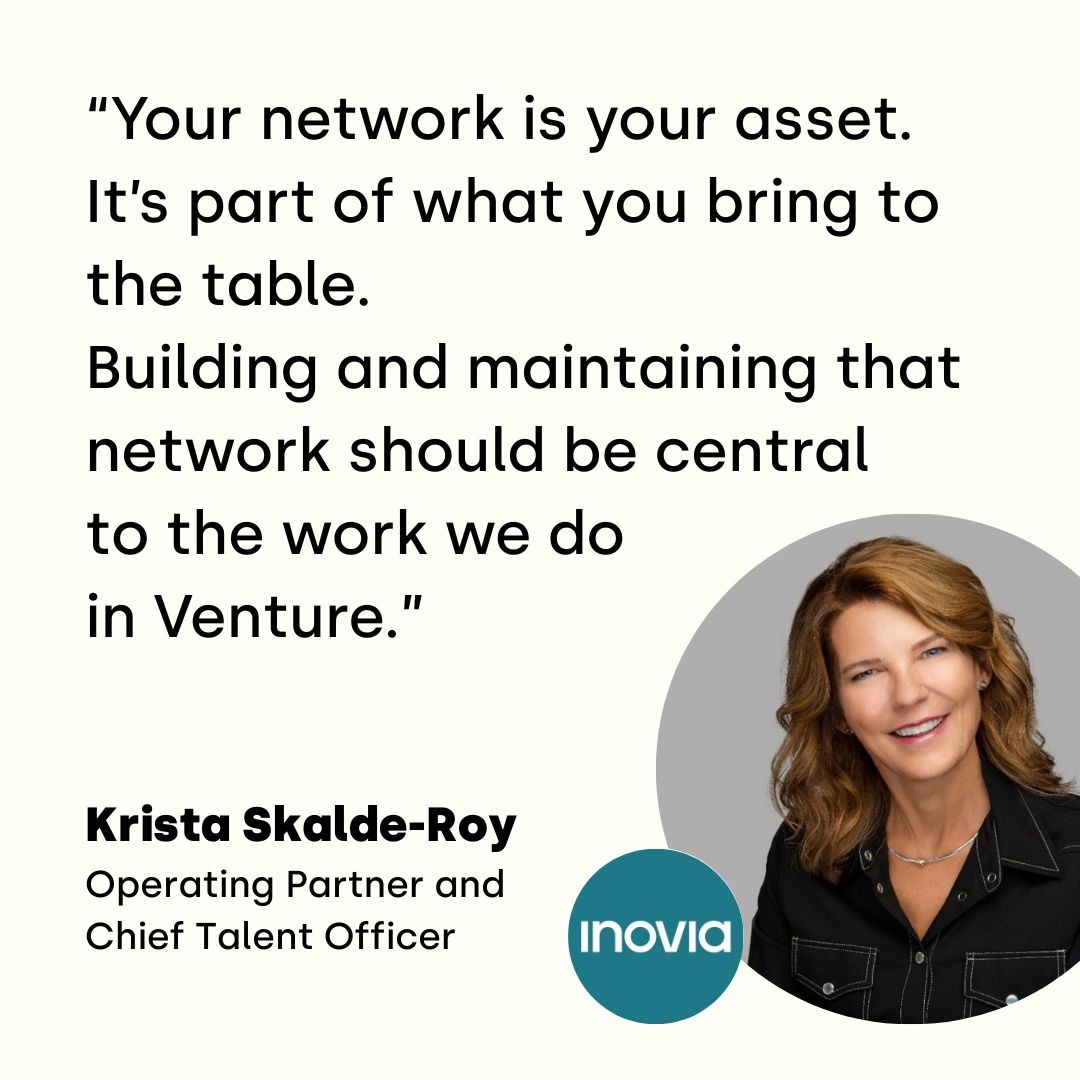
Chief Talent Officer & Operating Partner, Inovia Capital | Toronto, ON, Canada
Krista leads talent and people strategy at Inovia Capital, where she partners closely with Founders, Investment Teams, and Inovia’s internal Leadership to strengthen talent operations and unlock the power of the firm’s network across the entire portfolio.
Before joining Inovia, Krista spent nearly a decade in Abu Dhabi working with a sovereign wealth fund undergoing a large-scale transformation. With a uniquely global background and a passion for building systems that help align people with the achievement of business objectives, Krista brings a multidimensional perspective to venture. A philosophy grounded in curiosity, intentional relationship-building, and a belief that technology and human insight must work together to support Founders and Teams.
A: I’m probably not the best example of a linear career path. My whole career has been about taking risks and opportunities. Less about titles, more about different experiences. I always saw “people and culture” work as a huge puzzle with many pieces. Some pieces are not glamorous, like employee policies, but I learned the hard way that they matter.
I spent years in consulting, focusing on HR, leadership, and change management, but eventually felt the urge to transition in-house. As a consultant, you advise, you build slides, and then you leave. You never see things through. I wanted to live the work and finish something end-to-end.
That’s what took me to Abu Dhabi. We were living in Paris at the time. I was ready to make a move from the consulting role I was in, and got a call from an exec search firm about a role leading large-scale transformation at a sovereign wealth fund in the Middle East. My husband was open to moving, our son was young, and the timing was right. What was supposed to be 3 to 5 years became almost 10. And it was transformative: massive organizational rebuilds, new comp models, new teams, navigating huge change. But once it was complete, I was ready for the next challenge.
The investment teams I worked with started pulling me into light-touch value-creation work. Requests about talent strategies, human capital diligence, coaching. I came across an HBR article about talent partners in private equity, got curious, and during COVID, set out to speak to as many people in these roles as I could, trying to understand what they did and how it created value. One connection led to another, and eventually to a conversation with Inovia Capital.
A: One of our investment partners said something that stuck with me: “Venture capital is a relationship business. How will you overcome being out of the country for ~15 years and being able to leverage the “network effect” ?” It made me think deeply about the value of networks, not just personal but organizational.
I wasn’t wrong when I said my network was global. I had been working in a sovereign wealth fund, interacting with people from all over the world. Yes, I’d need to rebuild locally, but that doesn’t happen by chance. Networks are built with intentionality. With the right people and the right technology, you can accelerate that process. That partner’s challenge actually lit a fire under me, and it’s become a core tenet of how I approach talent in VC.
A: We’re a little different from other firms. Talent and Marketing are table stakes for a fund of our size. I’m a team of two; our VP of Marketing is a team of two.
Where we’re unique is that we also have:
We each have external and internal responsibilities. I lead internal HR; my counterpart leads internal comms.
A: You have to be ready for a lot of context switching, between companies at different stages, with different founders and exec teams. And, if the role also has an internal component to it (e.g. heading up talent or HR internally), there is even greater context switching - you really have to enjoy that kind of duality. Specifically on the talent side, people sometimes underestimate talent work, thinking you can “just do it all.” But people are hard. It can be messy. You need curiosity, stamina, and comfort with ambiguity.
A: I read two quotes recently that really stayed with me.
First: Imagine humans never worked… and one day we all had to start. How would we design work today, knowing everything we know now and given the tools available to us?
It forces you to question what parts of work are necessary and what parts should be automated or eliminated.
Second: As machines get better at being machines, how do humans get better at being human?
That one really hit me. Despite unbelievable advances in the past two decades that have definitely made us more efficient on a manual to automated scale, the “lift” is still very human-input, technology-enabled. . Now, thanks to AI, we are experiencing more human-directed AI input and output, with an ultimate goal of us focusing on: relationships, creativity, and empathy.
A: A big theme for me is deepening the value of networks.
I’d love a dashboard showing:
This would guide marketing, events, thesis work… everything.
Second, 3D people data. I don’t want to spend time researching whether someone worked at a Series A company between 2019–2021. I want the technology to tell me that so I can ask better questions and focus on the high-value parts of the conversation. For example, what was the experience like during that fundraise? How did you contribute value?
And third, AI. Platform teams have a massive opportunity to use AI to consolidate data, learn from it, and make more informed decisions across the firm. It won’t all be solved in 2026, but we can lay the foundations.
A: I’m excited. When Maveric suggested I speak with Findem, through the lens of a partnership, I was genuinely excited. Hari, Findem’s CEO, immediately demonstrated his understanding of the problem space and 3D people data. I thought, “This is perfect. We’ll work toward an integration over time.” With Getro joining Findem, I feel assured that you are working on accurate people data powering the workflows my team depends on.
Book a call to put your network to work.